
Best Practices for DevOps Implementation: Complete Guide

July 27, 2026 • 15 mins read • SoftSages Team • Managed IT Services
1. What Does "DevOps Implementation" Actually Mean?
2. Start With Measurement: DORA Metrics
3. Core DevOps Implementation Best Practices
4. Common DevOps Implementation Mistakes to Avoid
5. Putting DevOps Best Practices into Action
Most teams don't fail at DevOps because they lack tools. They fail because they adopt the tools without the discipline that makes them work. CI/CD pipelines get installed, containers get spun up, and releases happen faster — but reliability doesn't improve, incidents still take hours to resolve, and nobody can say with confidence whether any of it actually moved the business forward.
That gap is exactly where DevOps implementation tends to break down. Research consistently shows that elite-performing teams deploy dramatically more often than low performers while maintaining far lower change failure rates — but the share of teams that actually reach that elite tier has been shrinking, not growing, even as tool adoption climbs. The difference isn't access to better tools. It's whether the practices around those tools are implemented with real discipline.
This guide breaks down the DevOps implementation best practices that separate high-performing teams from the rest, covering culture, automation, security, observability, and cost optimization strategies that are increasingly critical to modern DevOps success.
What Does "DevOps Implementation" Actually Mean?
DevOps implementation is the process of operationalizing the DevOps philosophy — breaking down silos between development and operations teams — through specific practices, tooling, and measurable outcomes. It's not a single tool or a one-time project. It's an ongoing discipline that touches culture, process, and infrastructure simultaneously.
Done well, DevOps implementation gives a business three concrete outcomes: faster feature delivery, better system reliability, and tighter control over the cost of running it all. Done poorly, it just adds new tools on top of old problems.
Start With Measurement: DORA Metrics
Before changing anything, a team needs a baseline. The four DORA metrics — developed through long-running industry research — remain the standard way to measure DevOps performance:
◆Deployment Frequency — how often code successfully reaches production.
◆Lead Time for Changes — how long it takes from code commit to production deployment.
◆Change Failure Rate — the percentage of deployments that cause a failure in production.
◆Mean Time to Recovery (MTTR) — how long it takes to recover from a production failure.
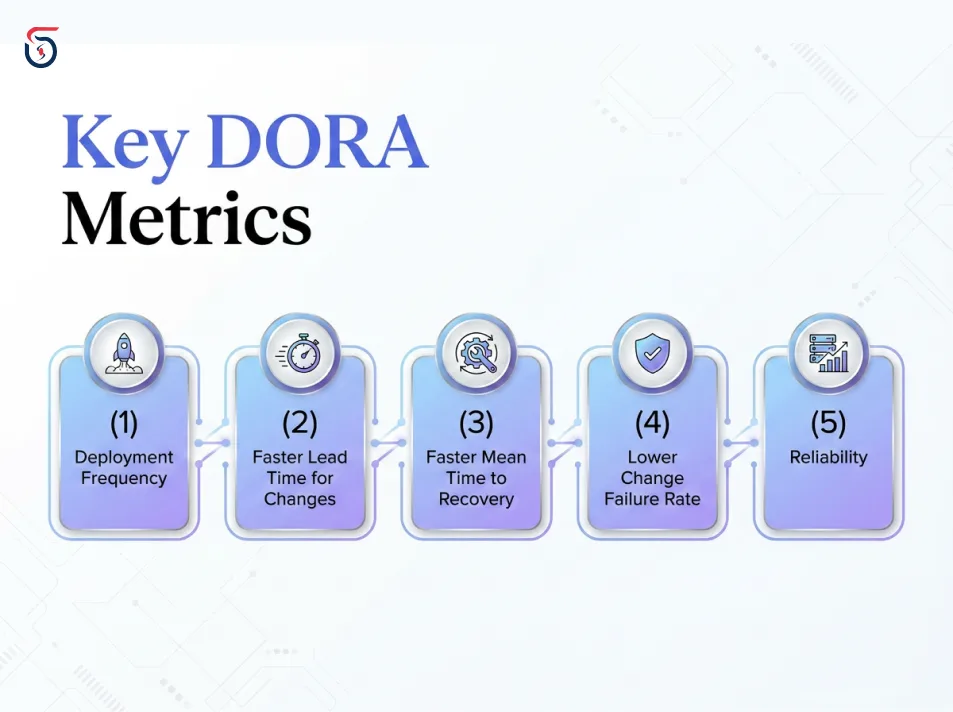
A critical nuance worth internalizing: deployment frequency alone is a weak proxy for actual business value. A team can ship more often while customer-facing reliability quietly declines, especially as systems grow more distributed. The healthier approach measures these four metrics together, alongside real business outcomes like customer impact and incident cost — not deployment frequency in isolation as a vanity metric.
Core DevOps Implementation Best Practices
1. Build a Genuine Collaborative Culture First
Tools don't fix a culture where development and operations still operate as separate, blame-shifting silos. Successful DevOps implementation starts with shared ownership: developers care about what happens after deployment, and operations has a voice earlier in the development process. Without that cultural shift, automation just speeds up the handoff of problems rather than preventing them.
2. Treat CI/CD Pipelines as Governance, Not Just Automation
Continuous integration and continuous delivery remain the technical backbone of DevOps, but the role of the pipeline has expanded. The mature pipelines function as enforceable contracts — the place where policy, security checks, and compliance requirements get applied consistently and auditably, rather than living in scattered documents someone checks manually before a release.
Practical implementation steps:
◆Automate build, test, and deployment stages end-to-end.
◆Keep deployments small and frequent rather than large and infrequent — smaller changes are easier to test, easier to roll back, and easier to debug when something breaks.
◆Build rollback strategies into the pipeline itself, not as an afterthought during an incident.
3. Adopt Infrastructure as Code (IaC) — and Extend It With GitOps
Managing infrastructure through version-controlled code (using tools like Terraform, AWS CloudFormation, or Pulumi) turns environment setup into something a team can review, test, and roll back, instead of relying on one engineer's memory of "how it was configured last time."
Many teams are now extending this with GitOps — where the desired state of a system is declared in Git, and automated agents apply that state continuously. This creates a more controlled, auditable record of exactly what changed, when, and why — which matters considerably for teams in regulated industries facing audits.
4. Build Security Into the Pipeline, Not After It (DevSecOps)
Security can no longer be a separate, late-stage gate. DevSecOps means embedding security checks directly into the CI/CD pipeline — automated code scanning, dependency vulnerability checks, and policy-as-code enforcement that validates every deployment against compliance rules before it ever reaches production.
This shift-left approach to security matters because vulnerabilities increasingly originate from the broader software supply chain — third-party dependencies, container base images, CI/CD tooling itself — not just the application code a team writes directly. Catching issues at commit time is dramatically cheaper than catching them in production.
5. Invest in Observability, Not Just Monitoring
Traditional monitoring tells you something broke. Observability — built on metrics, logs, and distributed traces — helps you understand why, especially across the increasingly distributed, microservice-heavy systems most teams now run. A genuinely useful observability setup connects a customer-facing event to the specific application trace, service log, and deployment marker behind it, so a team isn't manually lining up timestamps across five disconnected tools during an incident.
Standards like OpenTelemetry have made it considerably easier to implement consistent tracing across services without inventing custom instrumentation every time — worth adopting early rather than retrofitting later.
6. Consider Platform Engineering as You Scale
As DevOps practices mature, many organizations are formalizing them into internal platforms — self-service tooling, templates, and "golden paths" that let developers consume best practices automatically through their normal workflow, rather than rediscovering them under deadline pressure every time. This reduces variance across teams and means engineers spend less time reinventing infrastructure decisions that have already been solved once.
This doesn't need to mean building an elaborate internal platform from scratch — for many growing teams, it starts with simply standardizing the handful of golden-path templates that cover 80% of common deployment scenarios.
7. Bring Cost Discipline Into the Pipeline (FinOps)
Cloud cost management has moved from a monthly finance-team review to something engineering teams increasingly need to own directly. A meaningful share of cloud spend across organizations is considered wasted, and managing that spend is consistently cited as a top operational challenge.
Practical cost-governance steps:
◆Add cost estimation into infrastructure-as-code plans before changes get approved.
◆Set time-to-live policies on temporary or test environments so unused resources don't quietly run (and bill) indefinitely.
◆Build budget alerts directly into the pipeline rather than discovering overspend after the invoice arrives.
8. Use AI to Augment DevOps, Not Replace Discipline
AI is increasingly embedded across the DevOps lifecycle — from anomaly detection in monitoring tools to AI-assisted code review and predictive failure detection. But research is converging on an important caveat worth taking seriously: individual developers using AI coding assistants often complete more tasks and merge more pull requests, while overall organizational delivery metrics stay flat. The bottleneck usually isn't individual coding speed — it's everything downstream: review, testing, deployment, and operational readiness. AI amplifies whatever discipline already exists in a DevOps practice; it doesn't substitute for the discipline itself.
9. Test for Resilience Before You Need It
Rather than waiting for production incidents to reveal weaknesses, mature DevOps practices test resilience deliberately — using chaos engineering and fault-injection experiments to verify how systems actually behave under failure conditions. This shifts reliability from something reactive (responding well to incidents) to something designed in from the start, with evidence to back up the confidence.
10. Containerize Thoughtfully — Don't Over-Adopt Complexity Early
Containers genuinely simplify packaging and consistency across environments. But moving straight into self-managed Kubernetes before a team has the platform engineering maturity to support it often creates more operational complexity than it solves — inherited networking quirks, admission controller configuration, and storage class decisions that distract from actual product work. For most growing teams, managed Kubernetes services (like EKS, GKE, or AKS) make more sense than self-hosting until container orchestration is genuinely a core competency.
Common DevOps Implementation Mistakes to Avoid
◆Treating DevOps as a tools purchase rather than a practice change. Buying a CI/CD platform doesn't create the collaborative culture or process discipline that makes it valuable.
◆Optimizing for deployment frequency alone. Shipping faster while reliability quietly degrades is a regression dressed up as progress.
◆Bolting security on at the end. Late-stage security reviews catch problems after they're expensive to fix, not before.
◆Skipping observability until something breaks. Retrofitting tracing and structured logging during an active incident is far harder than building it in from the start.
◆Letting cloud costs become a surprise. Without cost guardrails in the pipeline itself, spend creeps until a finance review forces an uncomfortable conversation.
◆Assuming AI tools automatically improve team-level output. Individual productivity gains don't always translate to faster, more reliable organizational delivery without the surrounding discipline to absorb them.
Putting DevOps Best Practices into Action
Successful DevOps implementation isn't defined by which tools sit in your stack — it's defined by whether the practices around those tools are genuinely disciplined: measured against real outcomes, secure by default, observable by design, and cost-aware from the first infrastructure decision. The teams pulling ahead in 2026 aren't necessarily using more advanced technology than everyone else. They're the ones who've closed the gap between what their tools are capable of and what their processes actually enforce.
Getting there is rarely a one-time project. It's a continuous practice of measuring honestly, automating deliberately, and treating reliability, security, and cost as built-in properties of how software gets shipped — not afterthoughts bolted on once something goes wrong.
Adopting DevOps tools is the easy part. Making them actually improve reliability, security, and cost control is where most teams get stuck. SoftSages helps growing businesses implement DevOps the right way — from CI/CD pipeline design and infrastructure as code to DevSecOps integration and ongoing managed support across AWS, Azure, and GCP. and get a clear, no-pressure assessment of where your DevOps practice stands today.
Table of contents
What Does "DevOps Implementation" Actually Mean?
Start With Measurement: DORA Metrics
Core DevOps Implementation Best Practices
Common DevOps Implementation Mistakes to Avoid
Putting DevOps Best Practices into Action
Join Our Newsletter
Get the latest tech trends, tutorials and expert analysis delivered straight to your inbox.
FAQs about DevOps Implementation Best Practices
Core best practices include building a collaborative culture, automating CI/CD pipelines, adopting infrastructure as code, embedding security into the pipeline (DevSecOps), investing in observability, and measuring performance with DORA metrics.
DORA metrics are four standard measures of DevOps performance: deployment frequency, lead time for changes, change failure rate, and mean time to recovery (MTTR). They help teams measure real delivery performance, not just activity.
DevOps focuses on collaboration and automation between development and operations teams. DevSecOps extends that by embedding security checks and compliance policies directly into the CI/CD pipeline, rather than treating security as a separate, later-stage step.
Most DevOps implementations fail because teams adopt tools without changing culture or process. Common causes include siloed teams, security bolted on too late, missing observability, and measuring activity (like deployment frequency) instead of real outcomes.
IaC means managing infrastructure through version-controlled code rather than manual configuration. It creates consistency across environments, makes changes auditable, and removes reliance on one person's memory of how systems were set up.
Platform engineering involves building internal self-service tools, templates, and standardized workflows that make DevOps best practices easier for developers to follow automatically, reducing variance and operational risk across teams.
AI augments DevOps through anomaly detection, predictive monitoring, and AI-assisted code review, but research shows individual productivity gains from AI tools don't always translate into faster organizational delivery without strong underlying DevOps discipline.
FinOps is the practice of treating cloud cost as a first-class engineering metric. It's increasingly part of DevOps because unmanaged cloud spend can grow quickly, and embedding cost visibility into pipelines helps teams avoid budget surprises.
Not necessarily right away. Self-managed Kubernetes can add significant operational complexity for teams without platform engineering maturity. Managed Kubernetes services often make more sense for growing teams until that expertise is established in-house.
There's no fixed timeline — DevOps is an ongoing practice rather than a one-time project. Most organizations see measurable improvements in delivery speed and reliability within a few months of consistent practice, with maturity continuing to compound over time.